One of the key ways mathematics progresses is by first identifying a pattern in a more-or-less familiar setting, and then taking a leap by trying to extend this pattern to a more general environment—one that is, in some sense, larger than the previous one. Perhaps the old pattern still holds, or perhaps it doesn’t. In the latter case, our goal is to understand exactly where, in the leap of abstraction, it fails. Usually, the by-product of this process is the creation of an entirely new landscape of mathematical objects. On the one hand, these objects follow certain intuitive rules inherited from our original setting; on the other hand, they introduce fundamentally new structures. At any rate, the motto here is: with generalization, through abstraction, comes power—as we shall explore today.
The Integers: Our First Abstraction
Our story begins with the integers (denoted here by 


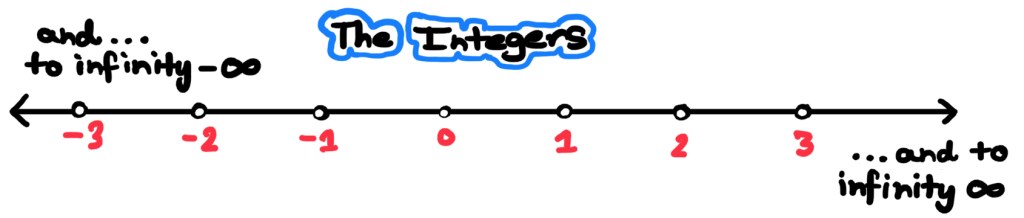
The integers aren’t terribly exciting just sitting there like dots, staring up at us – and they weren’t invented to just stay put anyways! Indeed, their raison d’être is to do calculations – like after measuring the length and breadth of a plot of land, say 

And just like that, we have our first, albeit painfully trivial, abstraction, a thing that is strewn in such high quantities across the mathematical landscape that it practically makes it up. The number
The next step after getting rid of all the unnecessary details (In the context of counting, this was simply replacing each instance of that particular object with the same indistinguishable token, so that only differences in the number count, as opposed to a difference in structure or the appearance. At other times, we may be interested in other properties of objects, so that we abstract differently — keep this in mind!) to create a set of ‘counting classes’, is to formulate meaningful rules to manipulate these ‘counting classes’. As we saw, thanks to the reasonably large degree of abstraction that went into creating the integers — in that one integer can stand for a frighteningly large diversity of objects — in the first place, these rules will carry quite a bit of power.
One such rule is multiplication: On one level, it’s just a procedure to convert an input of two integers into a single one (one of infinitely many so-called binary operations — try inventing a few yourself!), but it is deeply grounded in a concrete physical meaning — the area of a rectangle — as we saw. The other main rule is that of addition, which has a yetmore elementary physical interpretation: the total number of objects when many collections of objects are placed side-by-side. The last step, obviously, is to interpret the result of the abstract manipulation in the context of the situation!
Taking Off
Now, we play around with the integers, building up to our central characters — a very special subset of the integers.
You might notice that given integer 


One way to think about this is to first restrict our field of vision down to the set


First, for


This pattern halts, at least for once, at the third set:


As you might’ve already guessed,


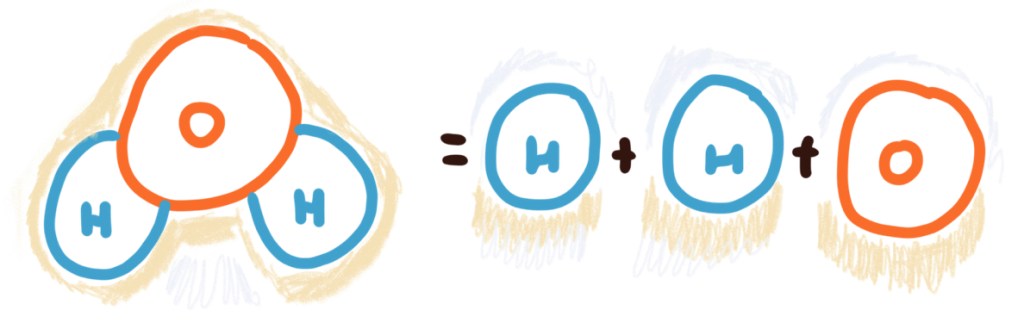
A playful analogy to draw here (and one that we will come back to surprisingly often) is to think of the primes as atomsand composite numbers like molecules from chemistry (we are not assigning primes to quarks for a very deliberate reason!). This analogy has many limitations, one of them being that prime numbers are infinite in number, whereas there are only finitely many stable atoms, but let us overlook these transactional details for the moment.
Indeed, this connection helps us come to terms with a notable property of the integers, that of unique factorization. Take the example of a molecule of water — essentially an oxygen atom stuck (the analogue of multiplication) to two hydrogen atoms. Notice that a water molecule will only ever be made up of atoms in this particular way: one


But this is not always true—only when we are naive and narrow-minded.
What’s Next?
Less abstractly, we’re going to move beyond the realm of the usual integers, creating new, integer like objects (mind you, there are not the integers, only similar), where the same element has two different prime factorizations—loss of unique factorization! These integer like objects will live in the complex plane, rather than the real line, as you shall soon see. Then, in an attempt to recover unique factorization in this new setting, we will find ourselves replacing individual numbers, with sets of numbers—and so we will succeed in creating a new object as a result of trying to extend a broken pattern.
Before we set (pun intended!) out on our adventure to foreign landscapes, let us take one last look at divisibility in
Divisibility and Sets
When we say


We start with the integers—evenly spaced and looking up at us as usual—and stretch on them, keeping 



Now, what happens when we place 
This is because the new pairs of arrows—one created by gluing two ‘JUMP

On the other hand, the result is not so satisfying if we place 

To sum up, we can view a single integer as a set—its version of the integers, which is its multiples—and divisibility can be seen as a containment of those sets.
And now, we create our new integers.
Travelling Beyond
Let’s take another look at
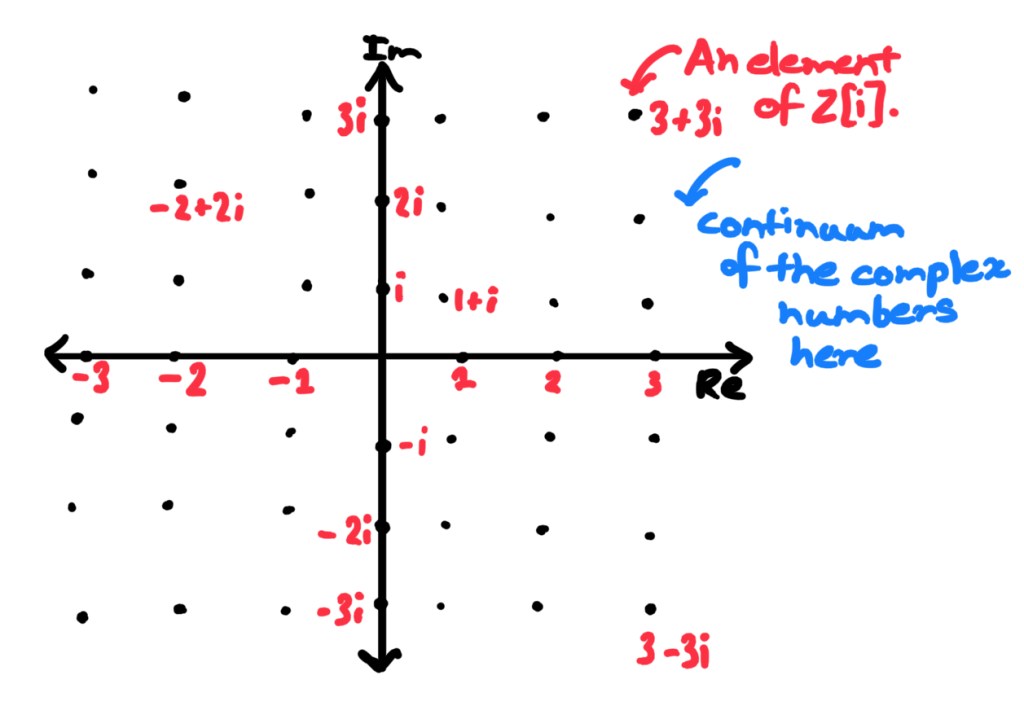
Well, mathematically speaking, the complex numbers describe a plane, just like how the real numbers describe a line. As a review, the complex numbers is the set

We’ll use
What’s more is that one can still add, subtract, and multiply any two such elements of


![\mathbb{Z}[i].](https://s0.wp.com/latex.php?latex=%5Cmathbb%7BZ%7D%5Bi%5D.&bg=ffffff&fg=000&s=0&c=20201002)
To make things seem a bit less abstract, let’s actually write down the rules for the arithmetic operations on
Explicitly,
 .
.
This sum is in


But this is naive thinking as well. Instead of translating the integers upwards and downwards by an integer, why not by an integral multiple of

Check it out! This picture also looks pretty convincing!
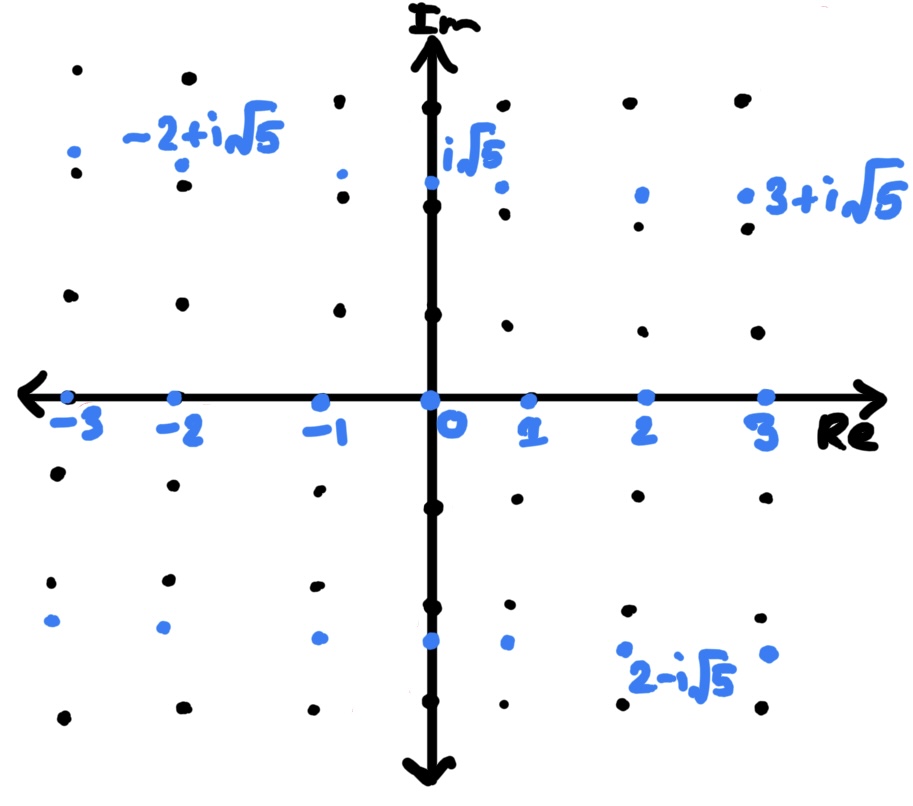
Another way to think about it is we’ve applied the transformation represented by the


to each element of ![\mathbb{Z}[i\sqrt{5}] = \{a + bi\sqrt{5} : a, b \in \mathbb{Z}\}](https://s0.wp.com/latex.php?latex=%5Cmathbb%7BZ%7D%5Bi%5Csqrt%7B5%7D%5D+%3D+%5C%7Ba+%2B+bi%5Csqrt%7B5%7D+%3A+a%2C+b+%5Cin+%5Cmathbb%7BZ%7D%5C%7D&bg=ffffff&fg=000&s=0&c=20201002)


What’s more—you can probably guess what’s going to happen—we can still add, subtract, and multiply elements of
The astute readers among you may not be quite convinced—yes,
And we could have completely done that—that set would still look discrete (try drawing a picture), and still have the basic arithmetic operations apart from division. The only problem with that would be that we would inadvertently lose —the multiplicative identity—in the process, and we kind of want that number to be around, as it was present in
Where are the Primes?
Before we can start doing some factorization in these new lands, as promised, we need to recover the notion of a prime. What does it mean for an element of ![\mathbb{Z}[i]](https://s0.wp.com/latex.php?latex=%5Cmathbb%7BZ%7D%5Bi%5D&bg=ffffff&fg=000&s=0&c=20201002)
![\mathbb{Z}[i\sqrt{5}]](https://s0.wp.com/latex.php?latex=%5Cmathbb%7BZ%7D%5Bi%5Csqrt%7B5%7D%5D&bg=ffffff&fg=000&s=0&c=20201002)
Well, it’s a usual integer 


Except that there are more trivial divisors—numbers that divide every element—than just
Let’s stick with 

All in all, it can be shown that the four numbers 
There is a way to see this purely algebraically as well: we are looking for ![a + bi \in \mathbb{Z}[i]](https://s0.wp.com/latex.php?latex=a+%2B+bi+%5Cin+%5Cmathbb%7BZ%7D%5Bi%5D&bg=ffffff&fg=000&s=0&c=20201002)

![c + di \in \mathbb{Z}[i]](https://s0.wp.com/latex.php?latex=c+%2B+di+%5Cin+%5Cmathbb%7BZ%7D%5Bi%5D&bg=ffffff&fg=000&s=0&c=20201002)


is automatically in
Next, we massage the expression for

Recall that both the real and imaginary parts must be integers, so that 
We can do something similar in 
We call
We say that an element 
And now we factorize 
The Breaking Point
Well, we all know that 


This might hardly seem surprising. After all, there are so many ways to write a regular integer as a product—as a baby example take 
But, in this case, all the involved 


“No way!” you shout! How can that be? 
But all we have to do is appeal to our freshly baked definition about irreducible—if 


First, let’s expand 


Now, we could expand the right side, but that is likely to get messy. Instead, we simply take the usual complex number absolute value of both sides,

We don’t want those pesky square roots, so we simply square both sides to get

Notice that both terms on the right side are usual integers, and the left side is obviously an integer—and so from an equation involving elements in
Remember what we want to do: show that one of 


- If
then we’re done—
(see why this is the case!). Similarly, if
, then the other factor,
this time.
- Next, consider
. This is simply not possible, as
is too large to be
, but
is not possible.
Phew! That was some algebra heavy-lifting! But at the end of the day, look what we have—


something hard to reconcile with our experience in
And with that, we transition into rescue mode. Can we, in some way, recover unique factorization in this new set-up?
Try Hard Enough and…
Kummer, a German mathematician, would have none of this corrupt,
Taking this thought quite literally, his idea was to have ‘numbers’ – notice the quotation marks – 


Now, on the one hand

and on the other hand

which would avoid all the drama! But what are these mysterious characters? Surely they can’t be numbers – elements of 
Let’s start by focusing on 


Essentially, this means that ![\alpha, \beta \in \mathbb{Z}[i\sqrt{5}]](https://s0.wp.com/latex.php?latex=%5Calpha%2C+%5Cbeta+%5Cin+%5Cmathbb%7BZ%7D%5Bi%5Csqrt%7B5%7D%5D&bg=ffffff&fg=000&s=0&c=20201002)
![\left\{2\alpha + \beta (1 + i \sqrt{5}) : \alpha, \beta \in \mathbb{Z}[i\sqrt{5}] \right\} \subseteq \langle \mathfrak{a}_1 \rangle,](https://s0.wp.com/latex.php?latex=%5Cleft%5C%7B2%5Calpha+%2B+%5Cbeta+%281+%2B+i+%5Csqrt%7B5%7D%29+%3A+%5Calpha%2C+%5Cbeta+%5Cin+%5Cmathbb%7BZ%7D%5Bi%5Csqrt%7B5%7D%5D+%5Cright%5C%7D+%5Csubseteq+%5Clangle+%5Cmathfrak%7Ba%7D_1+%5Crangle%2C&bg=ffffff&fg=000&s=0&c=20201002)
where we put those funny brackets around
But what is the set on the left really?
Well, it is just 

After a bit of thinking, one realizes that the containment 


All in all,

But, alas, as we already know, there is no single number whose version of
So, we must go one step further, dropping the bracket: 

It is because of the impossibility of writing the 
Notice that it is not just 


which is also going to be a set! What is
Well, in a similar way, one reasons out that

(recall that this is just the set of all possible sums of a multiple of
But then what is

What does it mean to multiply two sets?
We keep calm and use FOIL. More precisely, we just multiply a random element of the first set with another random element of the second set, and then do this for every pair of elements to get the product set.
Well, on the one hand, an element of the first set may be written as 

![\alpha, \beta, \gamma, \delta \in \mathbb{Z}[i\sqrt{5}]](https://s0.wp.com/latex.php?latex=%5Calpha%2C+%5Cbeta%2C+%5Cgamma%2C+%5Cdelta+%5Cin+%5Cmathbb%7BZ%7D%5Bi%5Csqrt%7B5%7D%5D&bg=ffffff&fg=000&s=0&c=20201002)

Did you notice? It’s a

and we have no difficulty in associating the right side with
We can apply the same line of reasoning to

Now, watch what happens when we multiply 


Along the same lines, while
What has this achieved? Well, clearly

and on the other side

We have recovered unique factorization! We just had to look beyond numbers and into some special sets.
 Numbers Matter